Let's review
Applying the battery: flying home
Applying the battery: flying home

Flying home on 20%: a battery audit of one airport day
Aileen Doyle · 12/07/26 · ~6 minuten reading time
- What this is: a Battery (Energy Accounting) audit, applied not to a product but to a single day, my journey home from Hungary the day after a wedding.
- Lived as: a neurodivergent traveller starting the day already in the red.
- Starting energy: roughly 20%, where 25% is my minimum to function without a health cost.
- The tool: The battery
- General impression: I made it home, and only because of the people and privileges around me. Flying home without them would not have been possible for me.
Getting to the airport is always a difficult, exhausting day. The distress starts in the morning, even if my flight is around dinnertime. Take my flight back from Hungary, for example.
The day starts in the red
It was the day after a wedding, so when I got up I could feel I was starting with my battery in the red. I’d guess I was at 20%, while 25% is my minimum to functioning without a health cost. Not the most hopeful start to an airport day.
I had some time to spend on a special interest, which did recharge me by 10%. Having some safe food for breakfast also gave me some mental peace, and another 5%.
Then the check out, and stressful bracing for a 40 minute walk to the village for breakfast and our bus. In the end, our friendly host offered to drop us off. This was a massive relief, but it didn’t restore that 10% I’d lost by stressing out about it. I wish our battery worked like that.
The journey out: café, bus, tram, taxi
A quick drive later, we entered the little coffee place we’d also had breakfast at the day before. My friend, a strong Hungarian with the sweetest heart of gold, still needed breakfast and a coffee. Sitting down I realised I’d reached the stage where sounds can literally be painful. The radio hurt my ears, and the loud unexpected sounds from the bar behind me, which hadn’t bothered me the day before, now drained me. The friendly maître of the café gave me a menu anyway, playfully noting that it would help me learn more Hungarian. In a way, I was relieved I didn’t speak the language: it cuts the chances of small talk down quite a bit.
My companion was very accommodating, and expressed appreciation that I knew my needs and voiced them. I’d asked for as little talking as possible, and whether it was okay to keep working on my special interest project on my laptop. He smiled and made clear that I was to do anything and everything that I needed, he was good with everything. This helped buffer through the café stimuli. Instead of costing me 10%, it only cost me 5%, thanks to Laszlo’s accommodations and me being allowed to escape into a smaller, more known world. Back to 20% again.
We headed to the bus stop, and I took out my ear plugs. I could sit where I wanted to, with Laszlo guarding our bags. I did become nauseous on the bus drive, despite just sitting with my eyes closed and no social interaction, or stress about next steps (Laszlo was taking the lead on that front). Another 10% gone. I truly hate being nauseous.
In a computer game, I think this is the point where the health bar gets so low that a continuous beeping starts making you aware of your impending doom. Laszlo took over my bags and guided me to the tram. I’d requested a place to stay and eat Italian for lunch where it was not busy at all. Sunday is a very busy day in Budapest, with many tourists needing to be somewhere. My friend succeeded glamorously in this goal as well. Within 15 minutes of leaving the bus, we entered a nice Italian eatery that was completely deserted. It was usually packed, he explained, but on Sunday around lunch Hungarians prefer to spend time with their families inside. As it wasn’t a touristy area, we had an airconditioned place to ourselves. One delicious pizza later (I even had multiple options to eat from on the menu, that always sparks joy for this restrictive eater), I was feeling manageable again. Looks like I’d charged back up to 25%. An hour of special interest later, I think I’d even gotten back to 35%.
We left, stopped by a nice coffee place for Laszlo (also empty, airconditioned, comfortable seats and music I liked at a soft volume), and went searching for a taxi. Good news about Budapest is, you’ll find a taxi soon enough, there are yellow cabs everywhere. Bad news, which I can imagine happens anywhere, is that our specific taxi driver started scrolling and interacting with his phone halfway through the drive. This made me afraid and angry, and I believe he caught a glance of my disgusted, hateful expression. He quickly stopped. If he hadn’t, I would have been extremely blunt about him having to stop it. Safety is never something you compromise on.
The airport itself
Once we had arrived, my friend came to the conclusion that it was the busiest that he’d ever seen the airport. That’s saying something for a Hungarian who had lived there for 30 years. Sitting at 25%, my energy levels did not like the look of what was to come next.
It was crowded, and hypervigilance was necessary not to bump into people. Getting through security control is something I’ve done often before in an airport, so even though it was my first time in Budapest airport, this part went by easily enough in its predictability. An intensely busy trek through a large shop was next (buy duty free, they always market it as a steal of a lifetime but it doesn’t seem to be that much cheaper). These shops are full of bright, flashy colours, many people moving through small spaces. I could feel my energy lowering again through the visual and auditory overstimulation. I needed a place that was less busy. If necessary, the lounge: expensive as it may be, that’s a much safer bet than anywhere else. We checked the restaurants in the hope for a peaceful booth, but no luck. We did, however, end up finding it relatively calm at a gate where there was no flight announced yet. Getting seats there, I set myself up with headphones and my laptop, and escaped into my special interest again. Another 50 minutes of waiting time to go until we could board. Energy level check-in: 10%, with 5% restoration after headphones and laptop. It would have been more, but the seat behind me was connected to mine, and every small change in posture of the guy sitting there moved my seat as well. It made me angry. It doesn’t often happen, but when I’m in a terrible state, I can become furious when the world goes over my boundaries even further. This was, of course, not the man’s fault. I still feel guilty for giving him a seething look, and watching him leave soon after.
Boarding: closest to tears
When it was time to board, I could feel that I was close to either tears or a panic attack.
My friend was in a boarding group with earlier priority than me, meaning that if I followed the instructions, I would have to board alone. This also risked the decision that they would choose my suitcase to be checked in, due to no more room for it in the cabins. I could feel the panic at these thoughts, and I asked Laszlo to help me one more time by requesting permission for me to board with his group, naming autism as the reason. I pulled out an autism card I had requested once from the Netherlands, knowing full well that this was not legitimate documentation and that they had every reason to deny my request. Tears were already in my eyes. Thankfully, seconds later, the personnel waved me in, and told my friend to help me look into preboarding next time. They asked for my boarding ticket, and I stumbled opening it, showing it with shaky hands. Eye contact was no longer possible for me at this moment, I just needed to focus on boarding the plane.
We started rolling our suitcases towards the entrance of the plane, but due to the uneven flooring it made a hell of a noise. I asked him to stop, instinctively putting my hands over my ears. I was planning on putting my headphones back on, and bearing through it, but without hesitation Laszlo picked up both his and my suitcases, and carried them forwards. The wash of relief and gratitude I felt made me tear up again. My nerves felt bare and fried, their endings clashing raw with every sensory stimulus available. I quickly got on the plane, stowed my suitcase, sat down and breathed a sigh of relief.
Until a few seconds later, a guy motioned that he needed to pass through. Of course. I had an aisle seat. Silently crying, I apologised and let him through. Staring into a point in the distance, I waited until another stopped beside me. I let her through, deadpan face and no eye contact, and then crumbled into myself. I put on my headphones and just sat there, hands clenched and hunched over. I didn’t react much to anything anymore. It was halfway into the air that I managed to start moving again. That was when I started typing out this story. It helped me breathe through what had happened. I tried to keep my flying fears at bay. I have been treated in the past with EMDR for fear of horrible things going wrong. I had been triggered just the day before by a guy insensitively offering a horrible new visual of something that had happened recently. I only saw it happen in my mind’s eye about 20 times during the flight. That could have been worse.
The home stretch
Once we landed in Belgium, I could feel I was in the home stretch. There was someone waiting to pick me up, someone loving and safe, and I knew that once in her car I could fall apart and let her take care of me. She hugged me deeply upon arrival and kissed me welcome home. I couldn’t keep my eyes open well anymore, I was twitching at all unexpected sounds, and I just let her lead me to the car. She installed me with a flask of fresh water, a cooling fan, and flowers she had brought to the airport for me. I felt loved and taken care of. I expressed that I would be going into standby during the car ride, and she encouraged me to do whatever I felt I needed. She accommodated me in all ways possible. Once home, she picked up nearly all my bags, and led my offline husk safely inside. Finally. Peace and predictability at last. The ordeal of the day was over. Time to start recharging from under 10% again, to become the person that people actually recognise me as.
The day, beat by beat
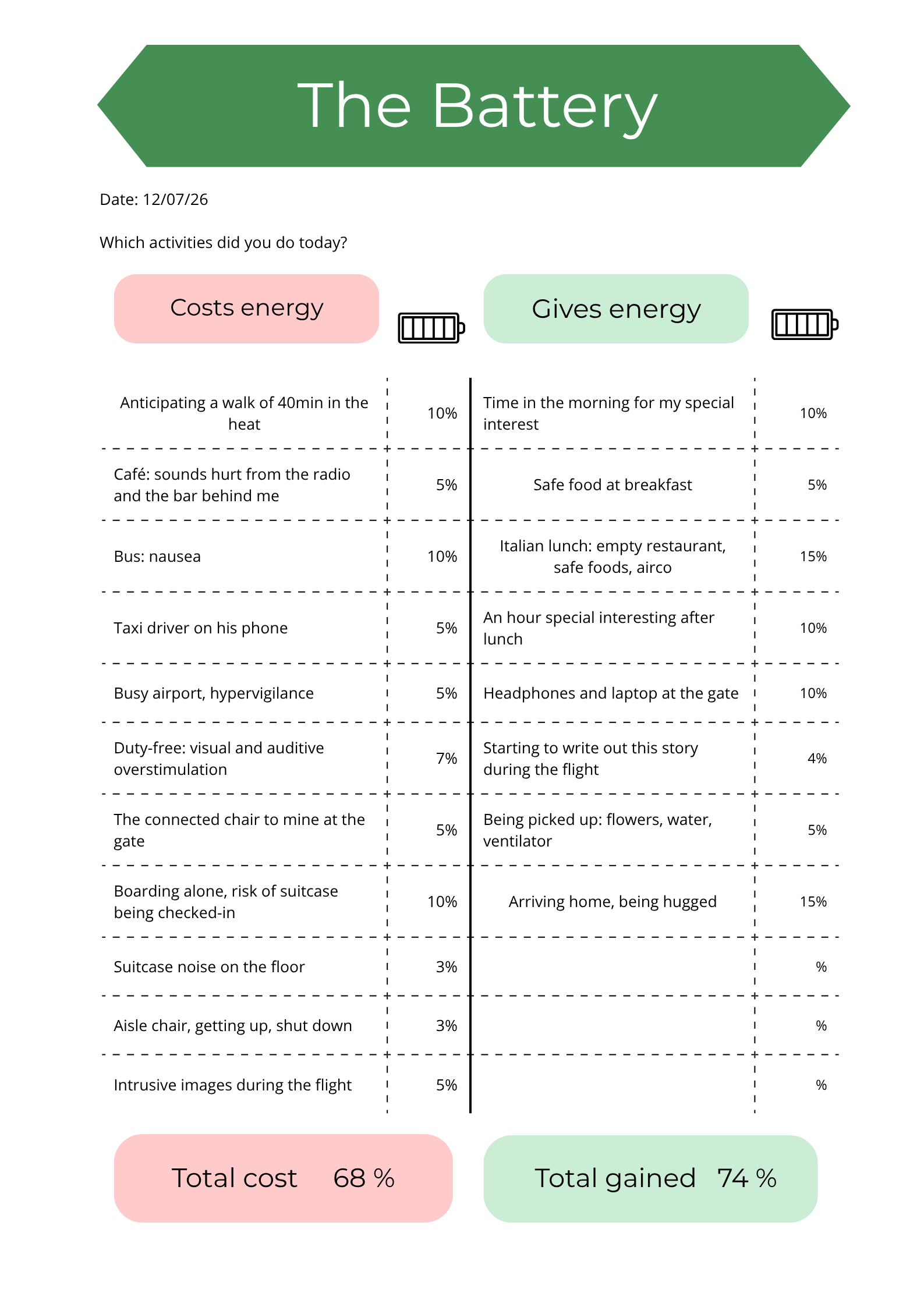
The same events in the order they happened, so you can watch the battery climb and crash. Anything under 25%, my functioning minimum, is where the day starts costing me health.
| Beat | Change | Battery |
|---|---|---|
| Waking up, the day after a wedding | start | 20% (!) |
| Morning time on a special interest | +10% | 30% |
| Safe food at breakfast | +5% | 35% |
| Bracing for the anticipated 40-minute walk | −10% | 25% |
| The café | −5% | 20% (!) |
| The bus, nausea | −10% | 10% (!!) |
| The Italian lunch | +15% | 25% |
| An hour of special interest after lunch | +10% | 35% |
| The phone-scrolling taxi driver | −5% | 30% |
| Airport crowds and hypervigilance | −5% | 25% |
| Duty-free overstimulation | −7% | 18% (!) |
| Headphones and laptop at the gate | +5% | 23% (!) |
| Boarding alone, and the suitcase check-in risk | −10% | 13% (!) |
| The suitcase noise on uneven flooring | −3% | 10% (!!) |
| The aisle seat, repeated standing, the shutdown | −3% | 7% (!!) |
| The intrusive imagery I couldn’t stop, first half of the flight | −5% | 2% (!!) |
| Writing this story, second half of the flight | +4% | 6% (!!) |
| Being collected: water, a cooling fan, flowers | +5% | 11% (!) |
| Home, and being hugged | +15% | 26% |
| Totaal | +6% | 26% |
The battery, tallied
The point of De Batterij is to make the invisible visible. Below is the day parsed into what it did to the battery. Read the cost column against the gain column, and notice how much longer it runs. That length is the whole point: these are hidden costs, more than anyone will realise unless flying like this is their own lived experience, or something a loved one has told them about.
The strategies that limited the cost
This is the audit of how I handled my day:
- Ear plugs, taken out at the bus stop before the noise built.
- Voicing my needs plainly (“as little talking as possible”, permission to work on my laptop), and a companion who honoured them without friction.
- Escaping into a smaller, known world (the special-interest project) as an active recharge, not a distraction.
- Safe food and safe eating environments chosen deliberately (breakfast, the deserted Italian place).
- Delegating the executive load to Laszlo: bags guarded and carried, the route led, the calm lunch spot found.
- The lounge-as-safety-bet logic: accepting a financial cost to buy a lower-stimulus environment when needed, even if it’s just a backup plan.
- Holding a hard line on safety with the taxi driver, non-negotiable even at low battery.
- The autism card and the preboarding request: using what documentation I had, and learning that preboarding is the route for next time.
- A safe person waiting on the other side, and letting myself go fully into standby once I could.
What I could have done, or would do next
- Consider registering for official preboarding in advance, as the personnel suggested, so boarding with support isn’t dependent on an improvised request. I still need to look into how to do this without feeling like I’m overreacting.
- If I have the budget for it, just go to the lounge.
- Try to schedule a buffer day between an intensive event and a flight home.
- Look into whether I can wear a sunflower lanyard. Again, look into if I can do this without feeling shame and a critical voice telling me I’m being dramatic.
The audit verdict
Where I’m proud of myself: Naming needs early, delegating executive load, and pre-choosing low-stimulus environments were the moves that kept a red-zone day survivable. Where I had control, I used it well.
Where I depend on external circumstances: Almost every save depended on external kindness or privilege, a friend, a diagnosis, the money to buy quiet. In the event that any of those had been absent, the day would not have been possible for me. That makes this a series of connections with others and coordinated rescues.
Finishing notes
This is the story of my internal experience while flying home yesterday. I am deeply grateful for the people in this story, they made the difference every step of the way. I say this knowing that I am privileged to have them in my life. Other privileges include having a diagnosis and financial options to minimise the overstimulation at times. Flying home without these privileges would not have been possible for me otherwise.
Which feels weird to say, as a 33 year old psychiatrist that’s mainly known for charismatic networking, enthusiastic lectures and working nearly every day on my passion projects (others call it work). Both versions of me are real, and the same is true for many other people with ADHD, autism, and other invisible health limitations or illnesses.
I’m not sharing this story to get the sympathy vote, but because it is important to have peers who also experience what you do. I hope this story makes people feel less alone, feel recognised in their own mental terrors, and maybe even inspire some new coping strategies when in an airport.
Thank you for reading.